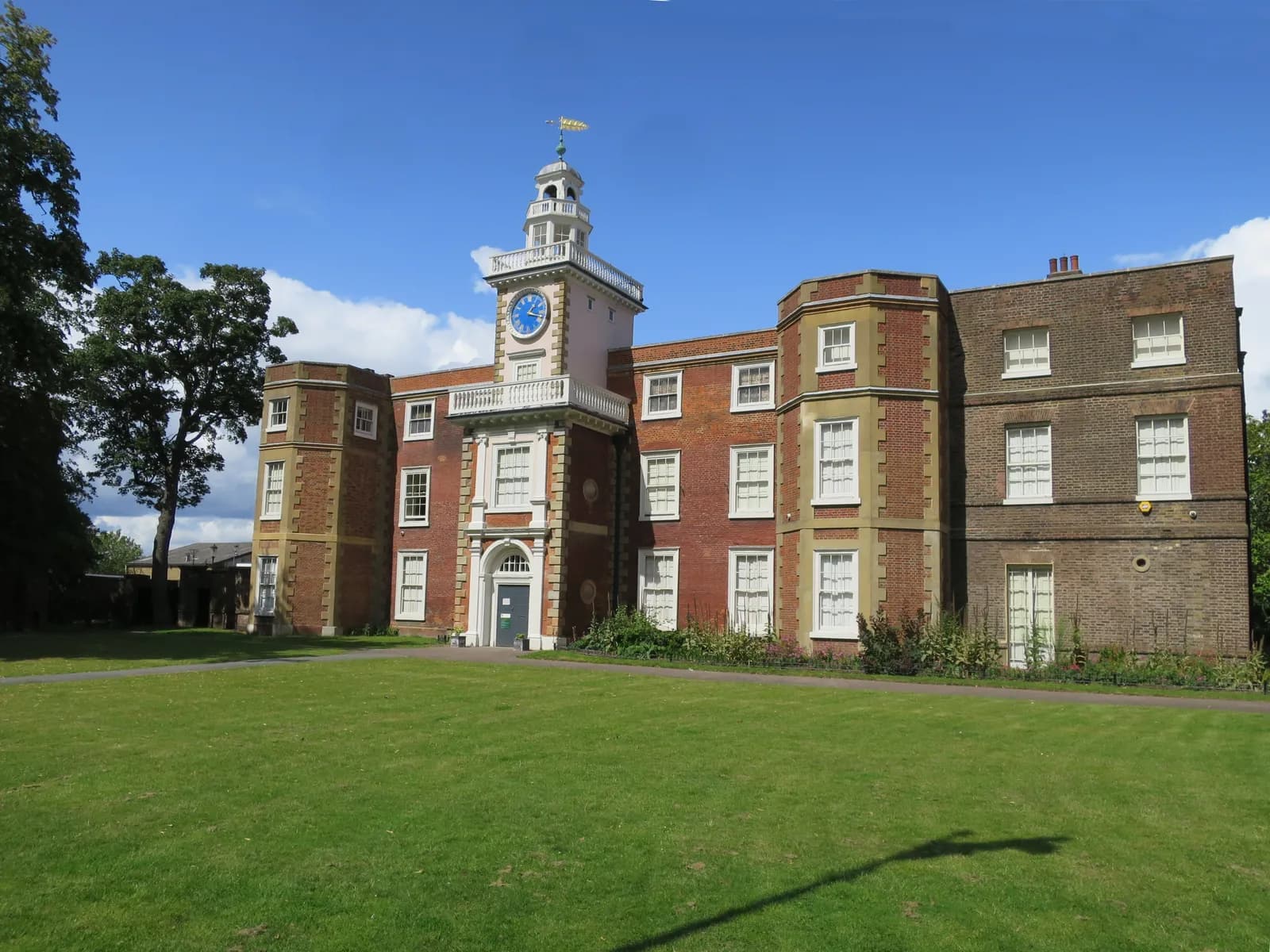
Bruce Castle stands as one of Tottenham's most significant historical landmarks, a Grade I listed manor house that has evolved from a Tudor residence into a centre of progressive education and local heritage. Built in the 16th century and later home to the Hill family, the building became the crucible of educational reform and gave rise to Rowland Hill's postal revolution that transformed global communication.
From Lordship House to Bruce Castle
The origins of Bruce Castle date to 1514, when Sir William Compton, a courtier to Henry VIII, acquired the manor of Tottenham. The house, originally named "Lordship House," was constructed in the 16th century and represents one of the earliest surviving English brick houses, marking a significant development in domestic architecture when brick was first being adopted as a principal building material.
In 1684, Henry Hare, 2nd Baron Coleraine, substantially remodelled the property. It was Hare who renamed the building "Bruce Castle," honouring the House of Bruce, the Scottish royal family who had previously held the Tottenham manor. The south façade of the building dates from this remodelling period. The mysterious round tower, standing 21 feet tall with walls three feet thick, predates the main house and may have 15th-century origins. Lord Coleraine himself noted in around 1700 that "in respect of its great antiquity more than conveniency, I keep the old brick tower in good repair, although I am not able to discover the founder thereof."
The Hill Family and Educational Radicalism
The building's intellectual legacy began in earnest when Thomas Wright Hill, a mathematician and schoolmaster, established Bruce Castle School in 1827. Hill was a radical thinker who counted Joseph Priestley, Thomas Paine, and Richard Price among his friends. When rioters attacked Priestley's home in Birmingham in 1791, Hill attempted to rescue the scientist's apparatus. Hill had invented the single transferable vote system in 1819 and believed firmly in education through "kindness instead of caning, moral influence rather than fear."
The school was established as a branch of Hazelwood School in Birmingham, which had attracted the attention of the French educational pioneer Marc Antoine Jullien and the philosopher Jeremy Bentham. Bentham was so impressed by Hazelwood's methods that he sponsored the Tottenham branch. The school's curriculum was revolutionary for its era, incorporating foreign languages, science, and engineering, and it rejected corporal punishment entirely. Transgressions were tried by a pupil court, and the governing philosophy held that "the teacher's role is to instill desire to learn, not to impart facts."
Rowland Hill and the Penny Post
Thomas Wright Hill's second son, Rowland, was born in Kidderminster on 3 December 1795. When the school opened in 1827, Rowland Hill became its headmaster, a position he held until 1839. During his tenure at Bruce Castle, Hill developed the ideas that would transform postal communication worldwide.
In 1837, Hill published "Post Office Reform: its Importance and Practicability," proposing a uniform penny postage rate regardless of distance. This radical simplification replaced a complex system where recipients paid fees based on miles travelled. The world's first adhesive postage stamp, the Penny Black, was introduced in May 1840, and the uniform penny postage rate came into effect on 10 January 1840. The impact was immediate; the volume of paid correspondence increased by 120 per cent between November 1839 and February 1840.
Hill was knighted in 1860 and served as Secretary to the General Post Office from 1854 to 1864. He died on 27 August 1879 and was buried in Westminster Abbey. His decade at Bruce Castle as headmaster preceded this global achievement, and the connection remains commemorated in the museum's postal history exhibition.
A Family of Reformers
The Hill family produced an extraordinary concentration of reformers. Matthew Davenport Hill became a Member of Parliament and prison reformer. Edwin Hill served as Controller of Stamps and as an engineer. Frederic Hill worked as a prison inspector. The siblings had been educated according to their father's progressive principles, and they carried these ideals into public life.
The school attracted pupils from across the globe, including the sons of Charles Babbage, the colonial governor Sir Henry Barkly, the dramatist Dion Boucicault, the explorer Frederick Selous, and the philologist Henry Sweet. The presence of diplomats' sons, particularly from newly independent South American nations, made Bruce Castle an internationally recognised centre of progressive education. A printing press designed by Rowland Hill and built by the pupils now resides in the Science Museum in London.
From School to Museum
Bruce Castle School continued under various headmasters after Rowland Hill's departure. His brother Arthur Hill led the school from 1839 to 1868, followed by Birkbeck Hill until 1877, and finally the Reverend William Almack until the school closed in 1891. A three-storey Gothic Revival extension added in 1870 bears the inscription over its doorway: "Whatsoever a man soweth, that shall he also reap."
The grounds opened as Bruce Castle Park in June 1892, becoming Tottenham's first public park. The museum itself opened to the public in 1906. Today, Bruce Castle Museum houses the archives of the London Borough of Haringey, a permanent exhibition on the area's history, the postal history collection honouring Rowland Hill, early photography collections, and historic manorial documents. The building contains one of the few public copies of the "Spurs Opus," chronicling the history of Tottenham Hotspur Football Club, whose badge depicts Bruce Castle alongside the Seven Sisters trees and the Percy lions.
Architectural Layers in Tottenham's Landscape
As a Grade I listed building, with its boundary walls separately listed Grade II, Bruce Castle preserves layers of English architectural history within its fabric. The Tudor origins, Stuart remodelling, Georgian additions, and Victorian school extension create a physical timeline of the building's evolution. A community archaeological dig in 2006 uncovered chalk foundations of an even earlier building on the site.
The building remains a testament to Tottenham's 19th-century reputation as a progressive residential area. When the Northern and Eastern Railway arrived in 1840, followed by the Great Eastern Railway's direct line to Liverpool Street with Bruce Grove station in 1872, Tottenham became a viable commuter suburb. The progressive educational philosophy of Bruce Castle School contributed to this reputation, attracting families who valued intellectual inquiry and reformist ideals.
Visiting Bruce Castle
Bruce Castle Museum stands on Lordship Lane, open to the public with free admission. The museum's collections span local history, postal heritage, and visual arts, including a significant collection of paintings by the Tottenham-born artist Beatrice Offor. Historic postboxes are displayed on the premises, and the building continues to serve as a centre for community heritage and research. The surrounding park, Tottenham's oldest public green space, offers 20 acres of grounds for visitors to explore.
The manor house that began as a Tudor residence, became a centre of educational radicalism, and now serves as a public museum embodies the layers of Tottenham's intellectual and social history. From the Hill family's progressive pedagogy to Rowland Hill's postal reforms, Bruce Castle remains a physical link to the ideas that shaped both the local community and the wider world.