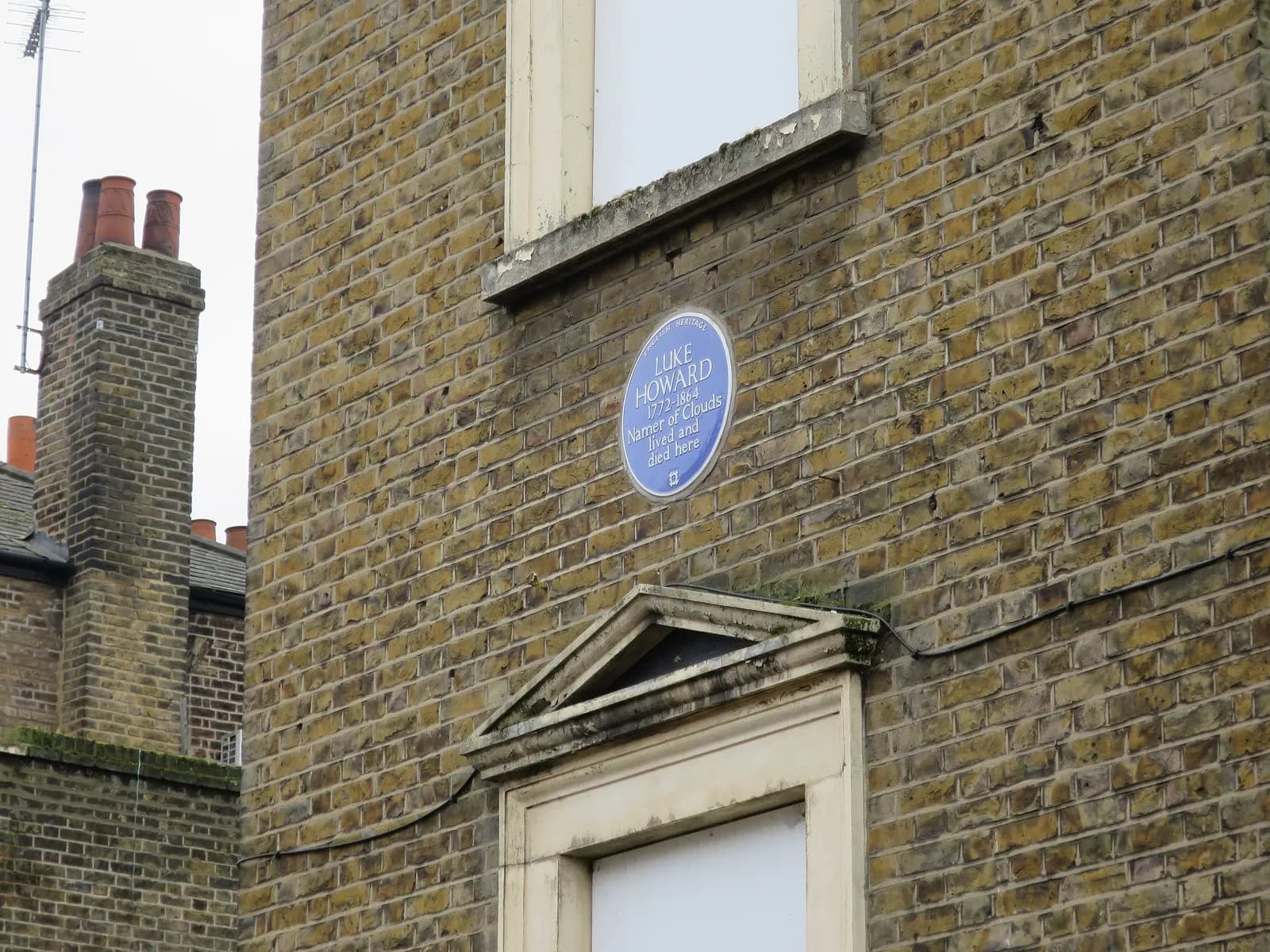
The blue plaque at 7 Bruce Grove marks the final home of the man who brought order to the skies above Tottenham. Luke Howard, who died at this address in 1864, gave the world the language we still use to describe clouds today.
Howard arrived at 7 Bruce Grove in 1852, following the death of his wife Mariabella. He would spend his final twelve years here, living with his son Robert, before passing away on 21 March 1864 at the age of 91. The Georgian townhouse, one of a pair of classical-style properties, remains the only building in Tottenham to bear an English Heritage blue plaque. Unveiled in 2002, the plaque reads simply: "Luke Howard 1772-1864 namer of clouds lived and died here."
From Tottenham to the Sky
Howard's connection to Tottenham extended well before his move to 7 Bruce Grove. Born in London in 1772, he had settled at 4 Bruce Grove in 1837 after returning from Ackworth in Yorkshire. His earlier years were spent establishing Howards and Sons, the chemical manufacturing business he founded in 1798. Yet it was his amateur interest in meteorology that secured his place in scientific history.
In 1802, Howard presented his paper "On the Modification of Clouds" to the Askesian Society, publishing it the following year in The Philosophical Magazine. Drawing on Linnaean classification principles, he proposed a Latin nomenclature for clouds that avoided mythological references, reflecting his Quaker faith. The three principal categories he identified; cumulus (heap), stratus (layer), and cirrus (curl of hair); remain the foundation of modern meteorology.
He added compound forms including cirrostratus, cirrocumulus, and cumulostratus (now cumulonimbus). The system was rapidly adopted. The poet Goethe was sufficiently impressed to write verses in Howard's honour, and the painters J.M.W. Turner and John Constable both studied his cloud classifications to inform their skyscapes.
The Urban Heat Island Pioneer
Howard's contributions extended beyond cloud naming. His 700-page work The Climate of London, published between 1818 and 1820, drew on four decades of daily observations. Within its pages, he became the first scientist to identify and describe what we now call the urban heat island effect, recording that London temperatures were 3.7°F (2.1°C) warmer at night than the surrounding countryside. He coined the term "city fog" for the smog concentrations he observed, work that the International Association for Urban Climates now recognises as founding the field of urban climate science.
A Building at Risk
Today, 7 Bruce Grove stands as a Grade II listed building, yet its condition tells a story of neglect. The property has suffered substantial internal collapse and appears on English Heritage's Buildings at Risk Register. Planning permission for refurbishment and conversion to flats was granted to Redwing Estates, though campaigners from the Tottenham Civic Society and Tottenham Clouds continue to press for urgent restoration.
The building holds additional layers of local history. In 1919, the Trade Union and Labour movements purchased numbers 7 and 8 Bruce Grove, opening an extension in 1937 attended by MPs R.C. Morrison and Fred Messer. This dual heritage; scientific and social; makes the property's current state particularly poignant.
Living Legacy
Tottenham has not forgotten its most famous meteorologist. When Tottenham Hotspur opened their new stadium in 2019, the club named the upper viewing areas "Stratus East" and "Stratus West" in tribute. The Tottenham Clouds organisation runs urban climate walks following Howard's observational routes, and a Luke Howard Weather Station operates in the area. In 2024, the Royal Mail issued a stamp honouring his contributions to science.
Howard was buried at Winchmore Hill Quaker Burial Ground in Enfield, but his greatest monument may be the language we use whenever we look upward. The terms he devised at his desk two centuries ago remain spoken daily by weather presenters, pilots, and anyone who has ever watched cumulus clouds drift across a summer sky above Bruce Grove.